
How to apply anti-gravel film to a car

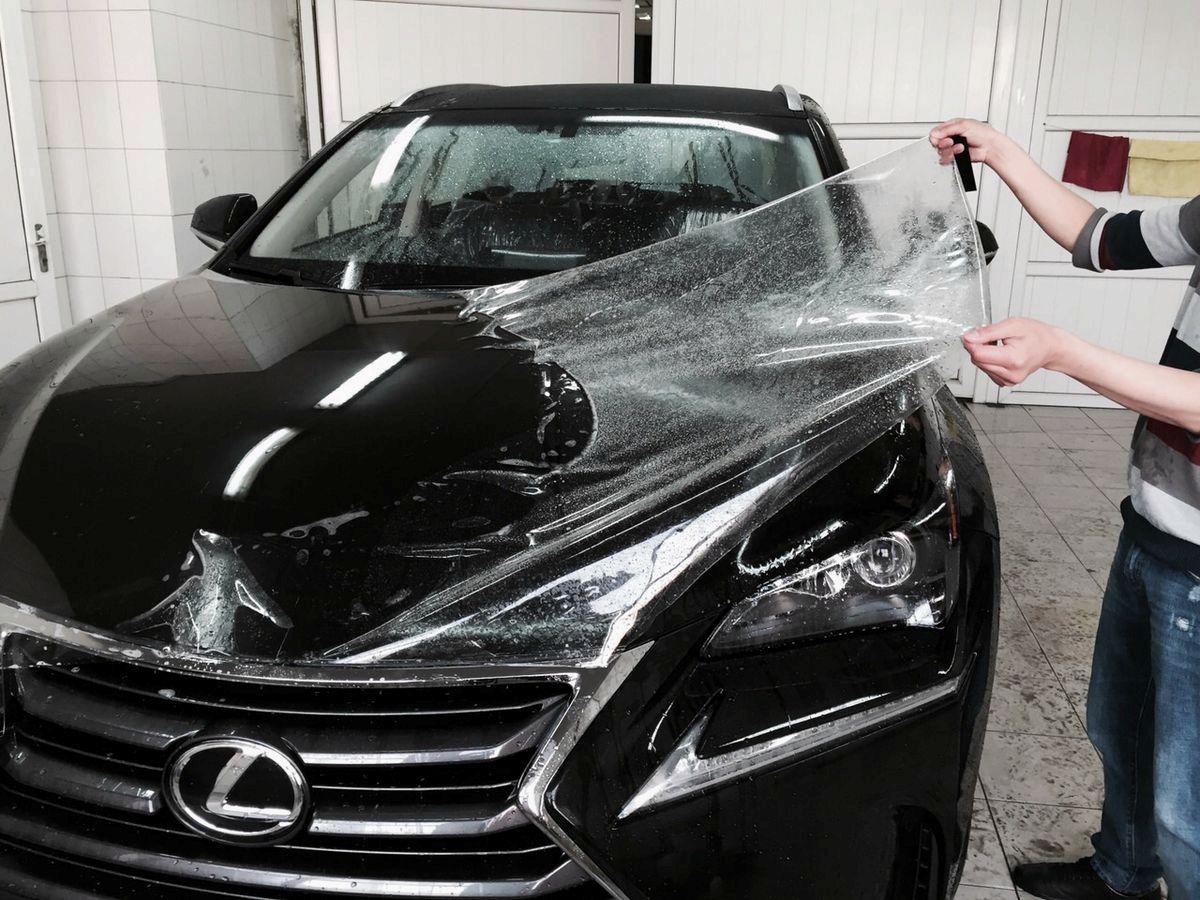
Anti-gravel film is often used to protect painted surfaces. The material prevents various types of damage to the paintwork and protects it from scratches and chips. Almost all types of film reduce the degree of fading of the body in the sun. In addition, drivers can apply the anti-gravel film themselves – this does not require special boxes or complex equipment.
Types of anti-gravel film
At the outlet, you will find a variety of movies from which you can choose the best option. All protective films can be divided into three groups.
- PVC;
- Polyurethane;
- Hybrid.
The simplest solution is PVC film. This material is inexpensive, but provides very reliable protection against damage. One of the disadvantages is the weak elasticity of the film. It rarely stretches more than 150%. This limits the possibilities for attaching complex sections of the car body.
Polyurethane films are more expensive. They provide less protection from damage, but have good stretch and excellent UV protection. Almost all polyurethane films are completely transparent and practically invisible on the body.
Hybrid films consist of a mixture of PVC and polyurethane. It combines the properties of both previous types of materials. Since it is often expensive, not all drivers are ready to use this material for car trim.
Hybrid films, and to a lesser extent polyurethane films, also have a special top layer. Provides self-tightening for minor damage.
Which film to choose
If you decide to cover the body of your car with anti-gravel film, you may have a question about what material to buy. There are many options and it is very difficult to decide this issue without consulting an expert. Let’s look at some options.
For partial body wrap. For example, PVC film is used for thresholds and casings. This decision is explained by the high protective properties of such films. At the same time, they do not need to be attached to complex parts of the body. This means that high ductility of the material is not required. In addition, these options are usually cheaper.
Polyurethane or hybrid films are suitable for wrapping the entire body. Due to its high ductility, this material can be glued even to the most curved elements of the car. The result is a smooth, beautiful finish.

The thickness of the film should also be taken into account. All common manufacturers supply materials with thicknesses from 100 to 210 microns. Here we need to focus on the main tasks involved in the body fastening process.
| Thickness | Transparency | Protection |
| 100-140 microns. | Almost completely transparent. Almost invisible on the body. Used where an inconspicuous finish is required. | Protects against only a minimal amount of stones. Good resistance to reagents. Does not protect against ultraviolet fading at all. |
| 140-180 microns. | Upon closer inspection, this film can be seen. Often matte. | Protects paintwork from most threats. Almost all films of this thickness retain ultraviolet radiation well. |
| 180-200 microns. | The film is visible without careful inspection. This can reduce visual appeal, so a gloss effect is often used to maintain a striking appearance. | The most reliable anti-gravel film. Some materials are not even afraid to try to damage the body with nails. Blocks up to 100% of ultraviolet rays. Typically used for finishing thresholds. |
It should also be remembered that decorative anti-gravel films are available for sale. They may have a certain color or repeat texture. In some cases, this is simply a black film that can be used to trim some body parts.
There are other nuances that need to be taken into account. All anti-gravel films are sold in large rolls of 12-50 meters. You may find that the film you choose only installs in larger packages and that 10-15 meters of material is sufficient for your vehicle. In this case, you will need to find a store willing to sell you the film with a different part.
What is needed for pasting
If you decide to seal the car yourself. You need to prepare materials and tools. You also need to take care of your clothes. Many people do not take into account aspects related to clothing, but to no avail. Metal buttons, locks and decorations can easily damage the paintwork. Therefore, wear lightweight, comfortable cotton clothing with minimal metal and plastic elements.
A hair dryer is necessary because of its ability to regulate the temperature. It is not recommended to overheat the film to temperatures above 70°C. Overheating degrades the technical properties of the protective film and damages the coating.
Drain off the soap solution. Simply dissolve a small amount of liquid soap in 1 liter of warm water. In extreme cases, you can use shampoo or dish soap.
An alcohol solution is also required. Make it based on one part alcohol mixed with three parts water. Usually you can use regular ethyl alcohol, but false propyl alcohol is recommended.
The tools you will need are the following, with the exception of a hair dryer
- Rubber spatulas;
- Spray;
- Stationery knife;
- Reusable soft cloth;
- Syringe (optional).
You will also need enough film. You can calculate the required quantity on the website of the material manufacturer. However, if you are making marshmallows for the first time, it is recommended to take 20-30% more. Due to inexperience, you can ruin part of the film, so the stock will not be affected.
No glue is needed, it is already applied to the film itself. Plus, you don’t need to use any adhesive. Soap solution is used as an activator for glue. In some cases, an alcohol solution can be used as an amplifier.
How to apply anti-gravel film
Before gluing the gravel film, it is necessary to properly care for the room. It should be light enough, but not drafty or windy. This means the material cannot be applied to vehicles on the street. The ambient temperature should be between +11°C.. +32°C. Under such circumstances, film will be best

Before applying the gravel film, it is necessary to prepare the car. To do this, it is washed. All contaminants are carefully removed. This especially applies to bitumen stains where dirt is sucked into. If there are “saucers”, it is better to remove them. In general, anti-gravel film is not recommended as a source of corrosion.
It also makes sense to prepare blanks for the main part of the body before starting work. This speeds up the process of covering the car with film. At the same time, the film should be painted with a slight indentation of about 2-3 centimeters on both sides. This way you can’t go wrong.
Sticker process
So, the tools are already prepared, the car is washed, the film is cut. Now you can go directly to the most important part of the whole process.
- Clean the body surface. To do this, you can use a ready-made alcohol solution. If this is not done, the contact between the film and the surface will not be very good. Sometimes the opinion is expressed that only painted cars do not need to be degreased. This is a false statement;
- Select a prepared anti-gravel film. Prepare it for gluing. To do this, spray a soap solution on the inside of the material. You must first remove the paper protection from the film. It is better to do this with an assistant, especially in large areas;
- Place the template on the treated area. Place it appropriately, without folding it if possible. The film remains movable for some time, and you can fix it;
- Take a hair dryer and heat the surface. At the same time, grab the film with a spatula. This must be done carefully, but very quickly. It is recommended to apply the film to roofs and other large body elements;
- When you stick all the film. Look for air bubbles. They must be expelled. Take the spatula again and heat this area with a hairdryer to expel the bubbles that move from the center to the edges. In some cases it is easier to penetrate the blisters with a syringe;
- We wrap the film around the corner. Heat it again with a hairdryer and wrap the material around the edge of the piece. This is very painstaking work, but it guarantees that there will be no problems during further operations. If necessary, the film can be stretched and easily stretched by 20-30%;
- If there is any excess film left, carefully trim it off using a utility knife. Here you need to act as carefully as possible so as not to damage the car’s paintwork.
Repeat the same procedure with other body parts. The hardest part is finishing the doors. They have handles that really get in the way.
Useful tips
Despite the apparent simplicity of the process, gluing the film is not so easy. There are many nuances that need to be known and taken into account. At the same time, drivers and car manufacturers have gained extensive experience in decorating car bodies with Artistrate films. Below are some useful tips that will definitely help you while working.
- In some cases, the shape of the gap in the sealed area is not limited. To avoid mistakes, you can use masking tape. Stick it along the boundary lines. This ensures that no mistakes are made when laying the film;
- Pasting with protective film car without assistance may make it difficult to remove the paper protection from the film. In this case, you can do the following: Apply a soap solution to your body. We removed the film from the paper at one end, glued this part to the body and pressed it with a pair of magnets. We then gradually cut the paper, gluing the film in place. Don’t forget to warm up your body with a hairdryer;
- Smooth the film with a spatula, holding it at a 45°-60° angle to the surface. This makes it more effective.
- Pay particular attention to the curves of the car. Smooth them with soft towels and spatulas. This helps prevent wrinkles.
- You should start applying the film from any convenient point. Some drivers try to position the film as precisely as possible and then press it from the center outward. However, in practice, other solutions can be used.
When choosing a film, avoid using films of different thicknesses. A common mistake is using thicker film for the sills and thinner for the upper part of the car. In this case, ridges form very quickly at the joint, and the protection from gravel is much shorter.
It’s best to choose a material based on the task. If you frequently drive on forest or gravel roads, maximum protection is essential. For urban and highway applications, thin films (100-120 microns) are sufficient.
Besides the bonding process, there are some care considerations for the film when applying it for the first time.
- Do not wash the car for 24 hours after applying the bodywork. During this time, the film will fully adhere to the surface. For the same reason, avoid going outside if the temperature drops below freezing around the day of your next trip.
- After applying the film, it’s a good idea to wipe the bodywork with a soft cloth soaked in alcohol.
- Do not use shampoos containing abrasives to wash the car for a week.
- Polishing the bodywork with abrasive paste is not recommended. This can only be done before heating the treatment area with a heat gun, using a soft polishing pad.
If done correctly, the protective film will last 7-10 years, depending on the specific usage and the material manufacturer.


