
What watercraft are classified as small craft

Water transport includes many vessels of various designs and technical characteristics. There are large-capacity vessels, luxury yachts, sports boats and even small inflatable boats. However, since it is impossible to create navigation rules for each type of transport, the law uses generalized terms, one of the most well-known concepts being small vessels. Today we will discuss this legal definition. We will look at the size of small vessels in the Russian Federation and, in fact, how this category of transport differs. To this end, this article provides the definition and classification of small vessels, periods of their voyage and areas of operation, as well as a brief analysis of the main legal nuances, such as registering a vessel in GIMS and obtaining rights. If you try buy rights to a small boat then this must be done through trusted organizations.
Contents of the article:
Which vessels are considered small and to whom they are subordinated
Since time immemorial, any engineering structure capable of floating on water and carrying passengers and cargo was considered a boat. Thus, the ship can be an ordinary raft, a cargo ship, or a huge passenger ship. However, in order to somehow distinguish between these types of transport, water inspectors introduced something similar to a small boat. Let’s look at what’s hidden behind them.
Thus, the definition of a small vessel in the Russian Federation in 2020 is as follows
A vessel is considered small if its total length does not exceed 20 meters, and the carrying capacity and cockpit space allow it to carry no more than 12 passengers.
Thus, most watercraft used for private purposes fall within these criteria. Examples include amateur fishing and hunting vessels and boats used for water tourism and sports, as well as boats used for crossing and domestic needs.
In general, the category of “small vessels” is very broad, and all of these vessels are under the legal supervision of the State Inspectorate for Small Vessels (GIMS). This service was established in 1984 and, throughout its operation, reported to various Soviet and Russian agencies, but was finally transferred to the Ministry of Emergency Situations of the Russian Federation in 2004. Today, the State Inspectorate for Small Vessels’ responsibilities include classifying vessels and enforcing safety and navigation regulations, issuing navigation licenses, maintaining general vessel records, and overseeing their proper technical condition.
Furthermore, please note that many users wonder whether small vessels are considered vehicles. To answer this question, let’s look at the definition: “transport is a means of transporting passengers and cargo.” Essentially, small vessels are undoubtedly vehicles, as each vessel is designed to perform these functions.
Small vessels in various classifications
Thus, we have learned, in general, what is considered small Russian vessels. Now it’s time to move on to a more detailed analysis. In practice, in addition to the GIMS category itself, the type of small vessel is also determined, which varies depending on the classification criteria. We suggest familiarizing yourself with the basic classification.
By purpose
The concept of small vessels refers to vessels for the carriage of passengers and cargo. However, although the purpose of these vessels may vary, all vessels are classified according to the following types:
- Transport vessels – used exclusively for the carriage of passengers and cargo. Keep in mind that only some small vessels in the Russian Federation are specifically transport vessels. Passenger capacity is limited to 12 passengers;
- For industrial activities – this category includes vessels used for economic or commercial purposes. For example, timber carriers, merchant vessels, scientific vessels, and expedition vessels;
- Special purpose vessels – distinguished by their design for a narrow range of specific tasks. Typically, this includes boats that monitor the safety of people on the water and environmental patrols for environmental protection;
- For individual excursions and recreation—this type includes private boats and motorboats used for fishing, hunting, sightseeing, excursions, amateur competitions, etc.
You might be interested in: small vessels: prices, specifications, popular models, and areas of application.
A category of sports boats can also be distinguished, but it is less common among small vessels.
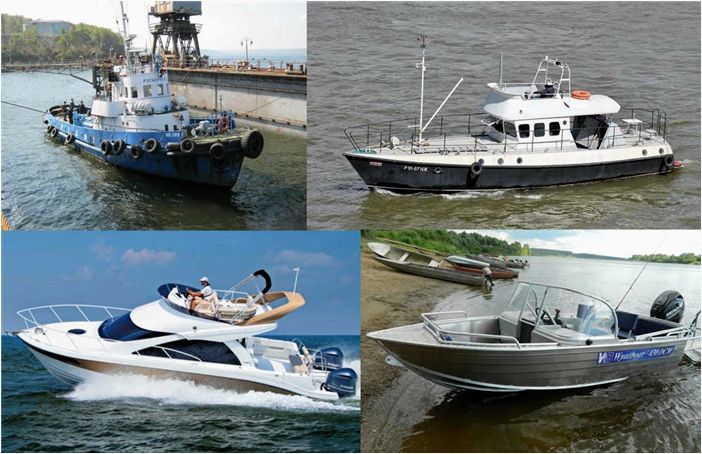
By design features
It is difficult to select a single selection criterion for classifying small vessels that relates to the nuances of boat design. Yes, the definition of small vessels specifies a hull length limit of 20 meters, but beyond this parameter, the design variations of the watercraft are unlimited.
Therefore, depending on the material of construction, containers can be divided into those made of metal, wood, plastic, rubber, and PVC fabric. In addition, there is a separate category of combined boats. Their design incorporates elements made of various materials. Boats of this type are called COMPOSITE.
According to the structure and directional features of the hull, all those classified as small vessels in Russian law can be divided into the following categories.
- Rowing boats;
- Motorboats (with outboard engines);
- Boats (with inboard engines); Boats;
- Yachts;
- Jet skis;
- Boats;
- Sailboats;
- Kayaks;
- Houseboats.
- Furthermore, each type of hull assembly can be classified. Containers can be installed longitudinally, mixed, or completely offset horizontally.
Particular attention is paid to the division into small vessel outlines. According to this criterion, the craft is processed with a flat, sharp, or round object. Furthermore, a distinction is made between mixed types (sharp and round) and seedlings—a well-aligned row of grooved (with a shelf below) or harmless (on the bottom) containers. Finally, the outlines can be catamaran-type (with two layers meeting at the bottom) or trimaran-type (with three layers).
By movement type
By type of movement
In the second classification, vessels are divided according to the method of movement into rowing, motor and sailing. At the same time, interesting boats, boats with stationary engines, boats with PLM, yachts and mixed boats, on which it is possible to use both sails and engines, stand out separately. By the way, there is also a division of judges by type of movement. The already mentioned oars and sails, as well as water cannons and propellers (rowing and air), stand out here. Thus, according to this criterion, there are interesting ships, sailing, waterfowl and screw.
And finally, it is worth noting another classification that combines structural features and performance parameters. According to her, all small vessels are divided into:
Contract – the ship’s hull replaces a certain amount of water. Thanks to this, the ship remains afloat (Archimedean action);
Planing – due to the high speed and design features, the bottom of such ships slides along the surface of the water, and water resistance is easily deposited;
- Hydrofoils – the wings under the ship’s hull produce large hydrodynamic forces, lifting the ship completely above the water;
- Air-cushioned – the housing is equipped with a high-power fan, which drives air under the bottom of the container, as a result of which the pressure increases and the water rises. Thanks to special equipment for cutting air threads, the high speed of such air cushion boats is achieved.
- It may be interesting to see: new GIMS rules for small vessels: registration, issuance of licenses, fines.
- In the navigation area
There is also a classification of navigation zones for small vessels: GIMS employees use this distribution in most cases:

In the navigation area
Inland waterways are freshwater basins of the Russian Federation and are subject to state regulation of navigation on inland routes;
- Internal and territorial seas – Radga and Lake Onega, as well as coastal seas of the Russian Federation, where small vessels are allowed to leave at a distance of less than 12 miles from the coast;
- International sea water is the basin of the world’s seas, including transport in the maritime regions of Russia. At the same time, the maximum number of miles a small vessel can be removed from the shore is 20.
- It should be noted that difficulty categories are typical for extreme navigation areas. Vessels are subject to increased safety requirements.
- In addition, there is another maritime classification. In accordance with this, the vessels are successively divided into.
port,
going out to the raid navigation area,
- operated in the waters of coastal navigation,
- maritime
- oceanic.
- Some small vessels are only 10 miles offshore and are subject to sea conditions of less than 4.
- The Boundary Waters also deserve special attention. Special rules may apply. For example, in some areas, access to water requires special permission from the local border agency. In addition, the boundaries passing through the water must be clearly delineated.
Navigation period for small vessels
The concept of small vessels also includes such points as navigation periods. Behind this phrase lies a number of dates officially approved by the State Inspectorate for Water Transport for the operation of water transport on local rivers, lakes and reservoirs.
Navigation period for small vessels
When do you need to register small boats?
They often ask when they need to put a “small amount” into a government account and where to go about it. Everything is simple here. The department is also involved in the registration of ships, since the concept of what a small vessel is and the corresponding classification of ships are defined by the GIMS.
When do you need to register small boats?
What watercraft are classified as small craft
What watercraft are classified as small craft


